Format
Skill Anatomy: SKILL.md, References, Scripts, Assets
A portable Claude Skill folder anatomy guide covering required frontmatter, instruction design, references, scripts, and assets.
Primary source takeaway: the Agent Skills format starts with
SKILL.mdand can include additional files that clients load as needed.
The minimal folder
The minimal skill is a directory containing SKILL.md. The frontmatter names the skill and describes when it should be used. The Markdown body gives the agent the operating procedure: steps, checks, examples, constraints, and references to any bundled files.
my-skill/
  SKILL.md
That small shape is enough for many editorial or review workflows. Add more files only when they make the skill easier to maintain, safer to execute, or more reproducible.
Frontmatter: name and description
The name should be stable, lowercase, and easy to refer to. The description is not marketing copy; it is a trigger contract. It should tell the agent and user exactly which task calls for the skill and which nearby tasks do not.
A weak description says "helps with design." A stronger one says "Use when creating production-grade frontend interfaces that need distinctive visual design and avoidance of generic AI aesthetics." The second version gives the agent a real matching boundary.
References: deep material on demand
Put long policy, domain, or API notes in references/ instead of stuffing everything into SKILL.md. The skill entrypoint should route the agent to the right reference when needed. This keeps the first loaded context small and lets the agent read deeper only after it knows the task variant.
Good reference files are named for decisions: brand-voice.md, api-auth.md, review-rubric.md, or invoice-rules.md. Avoid vague names such as notes.md when the folder may grow.
Scripts and assets
Use scripts/ when the workflow has deterministic work that should not be retyped from memory: rendering PDFs, validating schemas, extracting metadata, checking a fixture, or running a repeatable conversion. A script should be narrow, inspectable, and documented by the skill instructions.
Use assets/ for templates, example files, visual materials, boilerplate, and other reusable inputs. Assets are useful when the output must match a format that prose alone cannot describe reliably.
Visual model
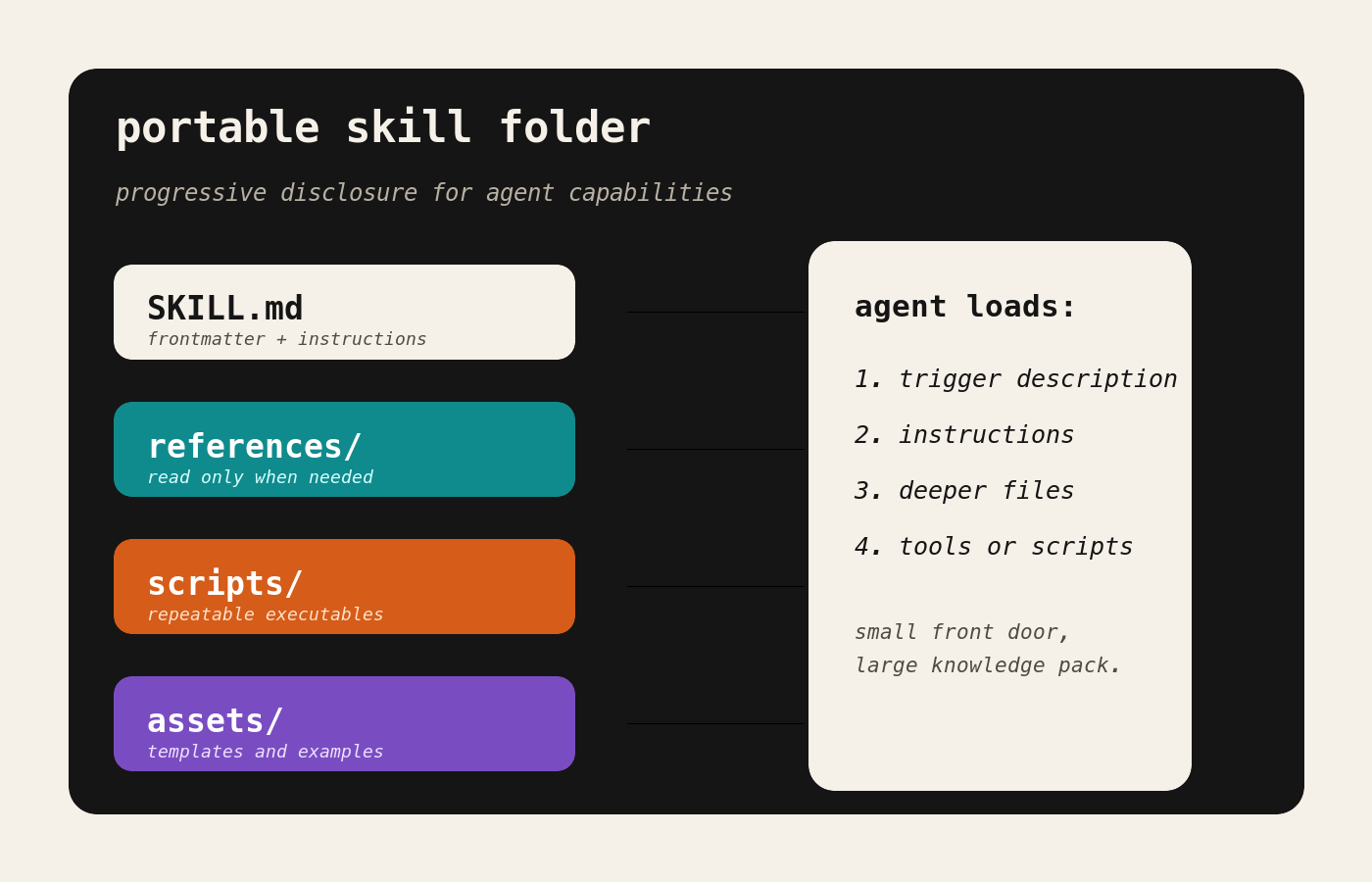
SKILL.md as the front door and moves heavier materials into named subfolders.FAQ
Is this site affiliated with Anthropic?
No. Claude Has Skills is an independent editorial guide. It links to Anthropic and Agent Skills primary sources so readers can verify product details directly.
Does a skill replace normal prompting?
No. A skill packages repeatable instructions and resources so the agent can load them when a task matches. The user still asks for a task, and the agent still decides what to read and run.
Do I need scripts in every skill?
No. Add scripts only when repeatable execution is safer or more accurate than prose instructions.
Should `SKILL.md` contain every detail?
No. Keep SKILL.md focused on activation and routing. Move long variant-specific material into references.
Primary Sources
Agent Skills specification
Agent Skills
Portable format reference for SKILL.md and bundled files.
Claude Code Skills docs
Anthropic Docs
Canonical source for Claude Code skill locations, types, and runtime behavior.
Best practices for skill creators
Agent Skills
Source for scoping, trigger descriptions, and progressive disclosure guidance.
anthropics/skills repository
GitHub
Official example repository with template and production-grade reference skills.